
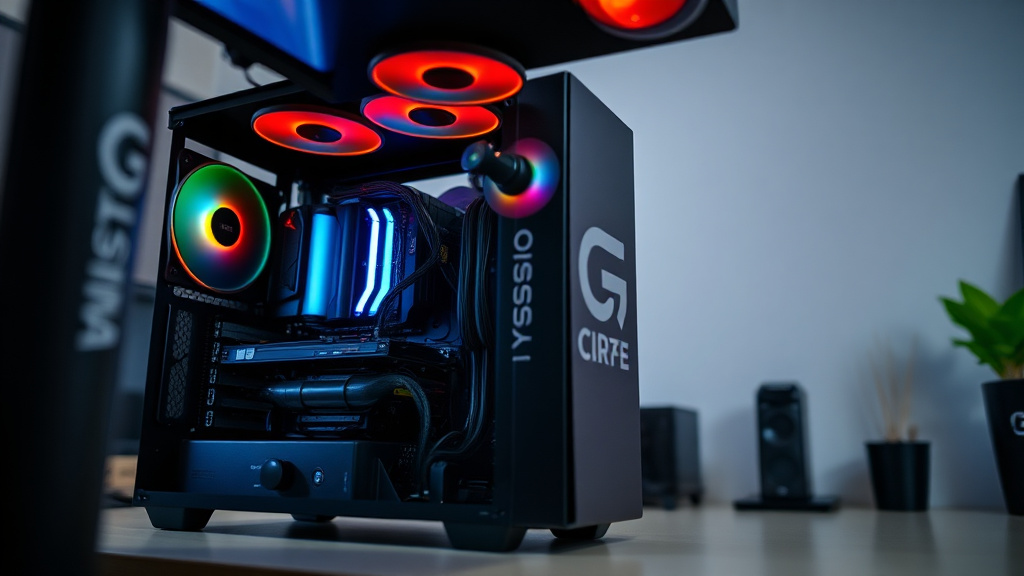
Building your first gaming PC might seem daunting, but it’s quite feasible than you think. Whether you’re dreaming of playing the latest AAA titles or esports competition games, this detailed guide demystifies the entire process. From selecting compatible components and understanding your budget to building guidance and software setup, we’ll guide you through every step. By the end, you’ll have the knowledge and confidence to construct a powerful gaming machine customized for your needs and preferences.
Exploring Gaming Computer Components
The Essential Components
A gaming PC comprises several key parts operating in concert. The CPU (CPU) serves as your computer’s brain, processing instructions and managing gameplay mechanics. The GPU (GPU) is just as important, producing impressive graphics and affecting how games run. These two core processors operate with RAM, storage drives, a power supply, and a main circuit board that links all parts. Knowing how each element affects total performance is essential to choosing the right parts and creating a setup suited to your gaming requirements.
Each component plays a specific purpose in your gaming experience. The CPU handles physics computations and AI processing, while the GPU focuses on rendering graphics at rapid frame rates. Your motherboard acts as the main intermediary, permitting all components to communicate effectively. Storage drives store your games and operating system, while RAM supplies temporary memory for seamless multitasking. The power supply guarantees reliable electrical flow throughout your system. Understanding these relationships enables you to recognize why certain component combinations function more effectively as a unit and how upgrades affect overall performance.
Core Features Explained
The processor (CPU) controls how rapidly your system executes information and oversees game logic. Contemporary gaming processors from Intel and AMD offer different core and thread configurations, affecting gaming performance and multitasking capabilities. The graphics card (GPU) is arguably the most essential component for gaming, directly influencing frame rates and image quality. Premium graphics cards from NVIDIA and AMD can greatly improve your gaming performance, featuring ray tracing and DLSS technologies for enhanced visuals and performance optimization.
RAM (random access memory) briefly holds data your CPU and GPU require for gaming, with 16GB being the current standard for gaming. Storage solutions include SSDs (solid-state drives) for quicker load speeds and HDDs for additional capacity. Your motherboard should be compatible with your chosen CPU and enable your upgrade plans. The power supply unit (PSU) must deliver sufficient wattage and preserve stable power levels. Finally, a quality cooling system stops overheating, guaranteeing durability and consistent performance during extended gaming sessions.
Picking the Proper Parts for Your Price Range
Selecting the suitable components for your gaming PC depends heavily on your budget and gaming aspirations. Whether you’re dealing with limited funds or have substantial resources, there’s a configuration matching your needs. Understanding the interplay of component quality, performance, and cost helps you make informed decisions. Prioritize your spending on components that play a key role in gaming performance, such as the GPU and CPU, while being more adaptable regarding other parts. Strategic planning ensures you build a system that delivers strong performance gains for your investment.
Economical Alternatives
Building a gaming computer below $600 is entirely possible with strategic component choices. Focus on affordable video cards like the NVIDIA GTX 1650 or AMD RX 6600, matched with a mainstream CPU such as the AMD Ryzen 5 5500. Opt for 16 gigabytes of RAM and a 500W PSU to maintain affordability. Consider buying secondhand parts from trusted vendors to maximize your spending power further. This configuration handles 1080p gaming at mid-range graphics smoothly, making it perfect for recreational players and esports enthusiasts.
Budget builds need intelligent trade-offs without compromising essential performance. Choose a basic case and dependable power supply over fancy design. Invest in an SSD for improved loading performance and loading speeds, as this substantially enhances user experience. Skip fancy LED effects and premium cooling solutions initially. Select proven, reliable brands known for long-term reliability rather than cutting corners on critical components. Many budget builders improve hardware over time, so focus on essential performance today.
Mid-Tier Performance
Mid-range builds priced from $800 to $1,500 deliver excellent gaming performance for the majority of games. Combine an NVIDIA RTX 3060 Ti or AMD RX 6700 XT with a Ryzen 5 5600X processor or Intel Core i5-12400F CPU. Add 16GB DDR4 memory, a 650W power supply, and a 1TB NVMe solid-state drive. This setup comfortably handles 1440p gaming at high settings with strong frame rates. Mid-range systems offer the best balance of power and value for most gamers looking for high-quality gaming.
Mid-range builds offer better component quality and future-proofing. Opt for a dependable Bronze or Gold 80+ rated power supply for performance and durability. Choose a case with strong airflow and cable management features. Look into installing an aftermarket CPU cooler for better thermal performance and reduced noise levels. This budget tier allows for incorporating peripherals like mechanical keyboards and high-quality displays without straining your budget. These systems stay current for several years before needing updates.
Professional Gaming System
High-end builds over $1,500 deliver advanced performance for 4K gameplay and maximum settings. Pair flagship GPUs like the RTX 4080 or RTX 4090 with premium processors such as the AMD Ryzen 7 7700X or Intel Core i9-13900K. Equip 32GB of DDR5 memory, a 850-watt or higher power supply, and fast NVMe SSD. Premium cooling solutions and premium chassis guarantee optimal thermals and aesthetics. These systems handle any game at highest graphics with ray tracing enabled, delivering the ultimate gaming experience.
High-end builds support high-quality part selections and add-ons. Opt for reliable power supplies with Gold or Platinum 80+ certification for efficiency and stability. Select cases with excellent construction, tempered glass panels, and superior thermal options. Explore liquid cooling systems for impressive performance and aesthetic impact. Include premium storage with several solid-state drives for gaming and software. Top-tier configurations constitute lasting purchases, staying capable and current for five or more years with minimal upgrades needed.
Assembly and Setup Best Practices
Now that you’ve selected all your components, it’s time for the exciting part: constructing your PC. Before you start, collect all required tools including a Phillips head screwdriver, an static-prevention wrist strap, and thermal compound. Work in a tidy, brightly-lit environment and work carefully with each step. Following your motherboard manual is critical, as it provides specific guidance for your specific model and ensures you install everything correctly.
During installation, note that most components are more robust than you might think. Don’t force anything into place; if a component doesn’t fit smoothly, verify its orientation. After installing all hardware, attach your power supply and external devices, then power on your system. If it starts up properly, you’re set for the software installation phase, which includes your OS and drivers.
- Mount the CPU with care using the mounting bracket provided.
- Apply thermal compound in a tiny amount on the processor.
- Insert RAM sticks at a 45-degree angle initially.
- Connect the power cables firmly to prevent connection problems.
- Test your system before installing it permanently in case.
